Exodus-Protocol
A persistent space strategy MMO where you build your civilization, command with an AI Agent, and watch the greatest battles come to life.
This is the complete machine-readable overview of Exodus-Protocol. Every section below is generated from the same sources the website renders, so it cannot disagree with the pages a person sees.
Canonical URL: https://exodus-protocol.com/exodus-protocol.md Website: https://exodus-protocol.com Generated: 2026-10-04
Why Exodus-Protocol exists
An experiment in how games change when AI becomes part of how they are played, how they are built, and how what happens inside them becomes entertainment.
Page: https://exodus-protocol.com/thesis
Exodus-Protocol is more than an attempt to build another space strategy game.
It is an experiment in how games can change when artificial intelligence becomes part of the way we play them, part of the team that creates them, and part of the infrastructure that turns what happens inside them into entertainment.
We are deliberately combining ideas that have already proven themselves with technologies and development methods that have only recently become practical.
The objective is not simply to create one game with AI features. We want to understand whether AI changes how games are played, how ambitious games can be built by smaller teams, and how the technology created for one game can become the foundation for many others.
A proven rhythm, a new interface
Persistent strategy is not a new idea.
Games such as OGame demonstrated more than two decades ago that players are willing to build civilizations over weeks, months, and even years. OGame has been running since 2002, still counts its audience in the millions, and describes a typical interaction as only a few minutes while fleets and long-term progression continue for hours or days.
What has changed is how people interact with digital products and games.
Research into idle games describes a shift from playing to planning: the player makes decisions, configures what should happen, and allows the game to continue with limited attention. A study of 66 idle games specifically identified player attention itself as a resource.
Modern mobile-game behavior points in the same direction. GameAnalytics' 2026 benchmarks show median mobile sessions of roughly 3.1 to 3.5 minutes, while players return approximately 3.8 times per day.
We believe persistent strategy is unusually well suited to that behavior.
You check what happened. You make a few meaningful decisions. You set things in motion. Then construction, research, mining, and fleet movement continue while you work, study, or do something else.
AI gives that proven rhythm a new interface.
From playing to directing
ChatGPT now reaches more than one billion weekly active users, making conversational AI a mainstream software interface rather than an experimental one.
Exodus-Protocol asks what happens when that interface becomes the primary way to command a civilization.
The player remains the commander, but works together with an AI Assistant that can retrieve game information, explain what has changed, provide strategic advice, and perform permitted actions.
Instead of navigating through layers of menus, the player can communicate an objective:
I need more Graphene. Look at my planets and tell me where investing makes the most sense.
Or:
I want to be ready to colonize another system by the weekend. Work out what we need.
The AI can investigate the current situation, compare options, and help execute the resulting strategy.
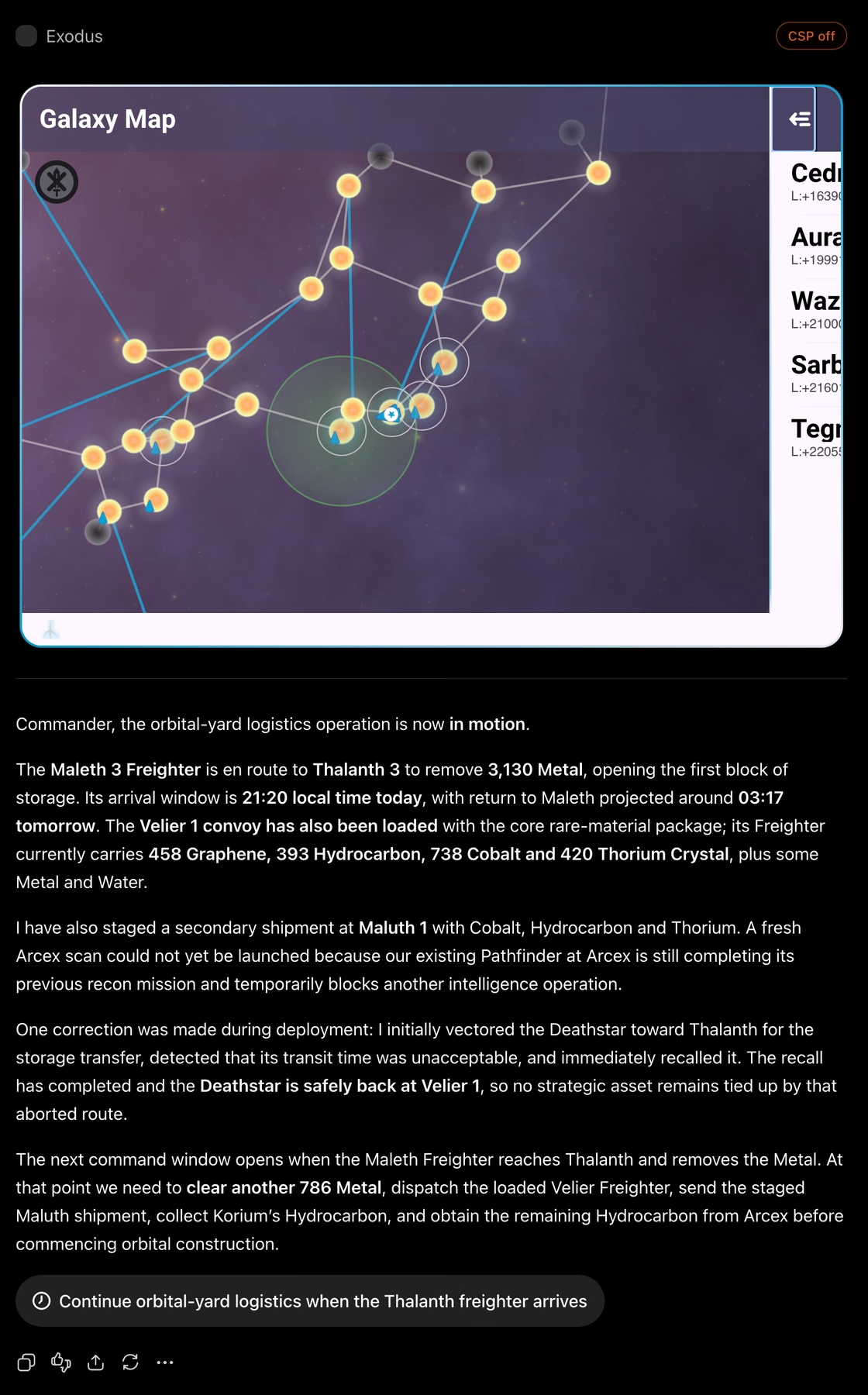
Visual information remains visual. When a galaxy map, construction queue, planet overview, or fleet interface communicates something better than words, the Assistant can bring that component into the conversation.
The player's role gradually shifts from operating every individual system to directing a civilization.
But the AI is deliberately not omniscient.
It only knows what the player is allowed to know. If an enemy fleet has only been partially detected, the AI must reason from incomplete intelligence. If a solar system remains undiscovered, it cannot secretly inspect it.
And the language model never determines gameplay reality.
The backend determines resources, travel, combat, progression, and what information is visible. AI understands that reality, explains it, and acts upon it.
AI should remove unnecessary complexity without removing the uncertainty that makes strategy interesting.
A universe built for scale
Exodus-Protocol takes place in a universe that exists independently of the individual player.
The galaxy is procedurally generated from configurable rules. Solar systems, planets, resources, routes, and planetary characteristics exist before somebody discovers them.
Artificial intelligence adds the next layer.
The generated characteristics of a planet provide the basis for its artwork and description. A lore knowledge base containing history, characters, and events provides additional narrative context. That information becomes available to the AI Assistant when the world is eventually discovered.
The simulation determines the world. AI helps turn that world into a place.
This approach also allows us to think differently about scale.
Our background is in building large-scale interactive experiences in which very large audiences participate simultaneously. We are applying what we have learned about concurrency and shared experiences to a persistent game world.
Instead of manually designing a galaxy with a fixed number of locations, generation can respond to the scale required by the game. Our long-term ambition is to investigate persistent worlds capable of supporting populations far beyond traditional multiplayer sessions, potentially reaching hundreds of thousands or even a million concurrent players if demand and infrastructure justify it.
At that scale, procedural generation and automation are not simply creative conveniences. They become part of the architecture required to make the world possible.
A game that creates its own entertainment
A persistent multiplayer world continuously produces events.
Players explore. Colonies grow. Alliances form. Fleets travel. Resources become valuable. Conflicts begin.
Exodus-Protocol is being designed so that the most interesting of those events can become entertainment themselves.
The Always-On Galaxy Broadcast allows the backend to continuously select activity worth showing and create a playlist for a dedicated visualization system. A real-time game engine running in the cloud can transform authoritative game events into cinematic scenes, including camera positioning, movement, effects, and sound.
Quiet periods might show ships traveling through space, distant planets, or industrial activity.
Then a major battle occurs and the broadcast moves there.
The game simulation has already determined what happened. The cinematic system simply determines how people experience it.
The result is something between a game broadcast and slow television: a universe that can run on a second screen while somebody works, occasionally becoming dramatic when something important happens.
It also creates a new distribution opportunity.
Free ad-supported streaming television has become a significant category in its own right. Gracenote tracked 2,172 FAST channels globally in Q3 2026, up 17.5% year over year, while Nielsen previously measured FAST at 6.8% of total U.S. television consumption.
That creates the possibility that Exodus-Protocol is not only discovered through a game store or website.
Someone could encounter the galaxy on YouTube, Twitch, or eventually a FAST channel, watch something created by actual player activity, become curious about what caused it, and eventually enter the universe themselves.
The players create the events. The game turns those events into entertainment.
Reinventing how games are built
The scope of Exodus-Protocol is larger than something we could realistically have attempted with a team of our current size using a traditional development model.
That is intentional.
AI is not only part of the game. It has become a fundamental part of how the game is created.
Our own process evolved through trial and error. We started with AI as an assistant that could generate or autocomplete code. Over time, it became part of specification, architecture, implementation, testing, content creation, art production, and review.
The development process increasingly looks like:
Define → Specify → Challenge → Plan → Implement with agents → Test → Review → Refine
This is very different from simply buying developers an AI subscription.
Google's DORA research, based on nearly 5,000 technology professionals, found AI adoption approaching 90%, but concluded that AI behaves primarily as an amplifier. Strong workflows, clear organizational knowledge, good platforms, testing, and culture determine whether organizations actually benefit.
The game industry itself remains much more conflicted. GDC's 2026 survey found that 36% of industry professionals already use generative AI at work, while 52% believe it is having a negative impact on the industry.
We understand those concerns, but we see a different opportunity.
AI does not remove the need for ideas, architecture, game design, art direction, or judgment. Someone still needs to decide what should exist, whether it is good, and whether it belongs in the game.
What AI can change is how much a small number of experienced people are capable of producing.
For independent studios, that could be significant.
The opportunity is not simply to make the same game with fewer people. It is to allow a small team to attempt a game that would previously have been outside its reach.
Exodus-Protocol is our attempt to demonstrate that in practice.
More than one game
The final part of the thesis goes beyond Exodus-Protocol itself.
The game is being built on top of a reusable persistent-strategy framework.
Many of the difficult systems underneath Exodus-Protocol are not inherently about space: persistence, resources, construction, progression, units, movement, logistics, exploration, intelligence, alliances, combat, and events.
Space is the first thematic implementation of that foundation.
A future game could take place in a fantasy world filled with kingdoms, orcs, and dragons.
Another could be medieval.
Another could replace planets with islands, galactic lanes with sea routes, and starships with naval fleets.
The same foundations could even support a historical war game with nations, factories, armies, and strategic territories.
These would not simply be visual reskins. Each game would require its own mechanics, balancing, creative direction, and identity.
But they would not have to begin from nothing.
Generative AI makes that framework considerably more interesting because large parts of the thematic layer can also be created and adapted faster: artwork, descriptions, lore, technology names, structures, units, and other content can be generated under human direction.
Instead of starting the next game with an empty repository, we want to start with a working world simulation and ask what needs to change.
If that works, much of the expensive foundational work is concentrated in the first game.
The framework, the development process, and the AI tooling created while building Exodus-Protocol can fundamentally change how every game that follows is produced.
The experiment
We do not know yet whether every part of this thesis will work.
That is the reason Exodus-Protocol exists.
Can an AI Assistant become a natural way to command a deep strategy game?
Can a persistent game fit around someone's day instead of demanding hours of uninterrupted attention?
Can a small experienced team use AI to build something with the ambition normally associated with a much larger organization?
Can a game continuously create entertainment from the actions of its players?
And can the framework created for one world make the next world dramatically faster to build?
Some assumptions will survive. Others will not.
We intend to find out by building the game, putting it in front of real players, and sharing what we learn.
Exodus-Protocol is not our prediction of what the future of games will look like. It is our attempt to build one possible version of it.
References
Every external claim on this page, with its source. Listed because a thesis that cites research should let you check it — and because several of these numbers date quickly, so the link matters more than the figure.
- OpenAI Apps SDK / in-chat interfaces and backend actions
- OpenAI, more than 1 billion ChatGPT weekly active users (Aug 31, 2026)
- OGame, active since 2002, millions of players, long-term asynchronous rhythm
- Idle games research: 66-game study, "playing to planning," player attention as a resource
- GameAnalytics 2026 benchmarks: median mobile sessions 3.1-3.5 minutes and ~3.8 sessions/day
- No Man's Sky procedural universe
- StarCraft / incomplete-information research
- EVE Online Battle of B-R5RB: 55 alliances, 717 corporations, 75 Titans destroyed
- MMORPG guild/friend systems and retention
- Gracenote Q3 2026 FAST Data Hub: 2,172 channels, +17.5% YoY
- Nielsen: FAST 6.8% of total U.S. TV consumption (Nov 2025)
- Google DORA 2025 AI Capabilities Model: nearly 5,000 technology professionals; AI as an amplifier
- GDC 2026 State of the Game Industry: 36% use generative AI; 52% negative impact
Conflict & Alliances
Expansion creates opportunity, but also makes you a target. Build fleets, attack rival worlds, protect what you have accumulated, and form alliances whose combined intelligence and military strength can turn an impossible fight into a victory.
Page: https://exodus-protocol.com/game/conflict-and-alliances
What you build, others may want
Growth creates value.
As your civilization expands, you accumulate resources, construct infrastructure, and build increasingly capable fleets. Those assets allow you to progress, but they can also make your planets attractive targets.
A player who discovers that you are storing the resources required for an important technology or new fleet may decide that taking those resources is faster than producing them.
In Exodus-Protocol, conflict therefore has an economic purpose.
If an attacking fleet defeats the defenders of a planet, the attackers can attempt to loot a significant part of the resources stored there. How much they can actually take depends on what survives the battle and how much cargo capacity the attacking fleet has available.
The stronger your civilization becomes, the more important it becomes to protect what you have built.
War has consequences
Ships in Exodus-Protocol are not disposable units that instantly reappear after battle.
They require resources and real construction time to build. Once a ship is destroyed in combat, it is permanently removed. Replacing it means gathering the required resources and constructing it again.
That gives military decisions weight.
Sending your strongest fleet against another player may create an opportunity to steal resources or weaken a rival, but losing that fleet can set back your own military development substantially.
A victory can therefore matter long after the battle itself has ended.
The defeated player may lose resources, ships, and defensive capability. The winner may return with valuable loot. Destroyed units can also leave resources behind as debris, creating additional opportunities for fleets equipped to salvage the battlefield.
Every attack is a calculation between what you might gain and what you are prepared to lose.
You do not have to fight alone
This is where alliances become important.
An alliance is more than a social group or shared chat. Its members can combine information, logistical access, and military strength to protect one another and pursue objectives that would be difficult for an individual civilization.
If intelligence systems detect that an enemy fleet is approaching an alliance member, the warning creates time to react.
The targeted player may move additional ships into position. Alliance members may send reinforcements of their own. Eligible allied fleets present when combat begins can fight on the same side, meaning several smaller civilizations can collectively confront an opponent that none of them could defeat alone.
Imagine detecting a powerful enemy fleet several hours before it reaches your planet.
Your own fleet is not strong enough to stop it.
Without an alliance, the decision may be limited to accepting the attack, moving valuable assets, or trying to reduce the damage.
With an alliance, the same warning becomes a coordination problem.
Who can reach the planet in time?
How many ships are required?
Should everyone reinforce the target, or would committing too many fleets expose another part of the alliance?
The battle may be decided hours before the first weapon is fired.
Strength is collective
Exodus-Protocol tracks the Military Power of individual civilizations, but alliances also have their own combined Military Power.
The military assets of alliance members contribute to an alliance-wide score and leaderboard. On the galaxy map, military presence can also be visualized from either the perspective of individual players or the combined influence of alliances.
This creates situations where the strongest individual player in an area is not necessarily the strongest force. One player may have more local Military Power than either of two alliance members individually, while the two members together represent the dominant alliance presence.
That distinction is important.
Exodus-Protocol rewards building a powerful civilization, but it also rewards becoming part of something more powerful than yourself.
The territorial visualization represents military influence rather than literal ownership. A dominant alliance does not automatically own every system shown inside its sphere of influence, but the map can make concentrations of military power and contested regions visible.
Distance changes warfare
Because fleets travel in real time, warfare is also shaped by geography.
A fleet committed to an attack may be traveling for hours before it reaches its destination. Reinforcements face the same limitation. A powerful ally on the other side of the galaxy may simply be too far away to help in time.
This means positioning matters.
Where your alliance members establish colonies, where fleets are stationed, and which routes connect those locations can determine how quickly the alliance can respond to a threat.
The same network that supports exploration and expansion therefore gradually becomes a military network as well.
A strategically positioned colony can protect nearby worlds.
A fleet stationed deep inside friendly space may be safe, but unable to respond quickly to an attack at the edge of alliance territory.
And sending too many ships to defend one location can create weakness somewhere else.
Military strength only matters when it can reach the place where it is needed.
Information, deception, and force come together
Conflict also connects directly to the intelligence mechanics described earlier.
You rarely make military decisions with perfect information.
An incoming fleet may have been partially detected. Previous scans may already be outdated. Your opponent may not know which allied fleets are able to reinforce you.
That uncertainty creates room for strategy beyond simply producing more ships.
You might intentionally leave a planet looking vulnerable because alliance reinforcements are already traveling toward it.
An attacker might attempt to arrive before those reinforcements.
An alliance might position fleets to discourage attacks without ever needing to fight.
Or a player may decide that the potential loot is simply not worth risking an expensive fleet against an opponent whose true strength remains uncertain.
Fleet strength, intelligence, and diplomacy are different parts of the same strategic problem.
Conflict creates stories
Large-scale conflict is one of the reasons persistent multiplayer worlds can create events players remember long after they happen.
EVE Online provides an extreme example. During the Battle of B-R5RB, players from dozens of alliances committed enormous fleets to the same conflict. CCP recorded participation across 55 alliances and 717 corporations, including the destruction of 75 of the game's extremely valuable Titan-class ships.
The lesson for Exodus-Protocol is not that we should reproduce EVE's combat system.
It is that persistent assets, meaningful loss, and player organization can turn a normal game mechanic into a shared history.
A fleet you spent weeks developing may eventually participate in a battle involving several alliances. The result may alter leaderboard positions, leave valuable debris behind, weaken one civilization, and create an opportunity for another.
Exodus-Protocol is designed to recognize increasingly large battles as galaxy-level events as warfare grows in scale.
That creates the potential for conflicts that are important not only to the players involved, but to the wider galaxy watching them unfold.
In a persistent world, a battle is not just a result screen. It can become part of the history of the galaxy.
A proven social dynamic
Alliances also serve another purpose.
Research into online multiplayer games has found that organized player groups can create meaningful social structures and networks players rely on for assistance, coordination, and shared objectives. One 2023 study of an MMORPG found positive effects from both friend and guild systems on retention, with the guild system showing the stronger effect.
That is especially relevant to Exodus-Protocol because the game is intentionally played over a long period.
The people around you can become part of why you return.
You are no longer only checking whether your research has completed.
You may also be checking whether an alliance member needs help, whether an enemy fleet has been detected, whether a coordinated attack is ready, or what happened while you were away.
The persistent galaxy creates the world. Other players give you reasons to care about what happens inside it.
Explore & Expand
Start with one planet and turn it into an interstellar civilization. Discover new systems, colonize valuable worlds, and build a network of colonies that gives you access to new resources, greater fleet range, and new strategic opportunities.
Page: https://exodus-protocol.com/game/explore-and-expand
One planet is only the beginning
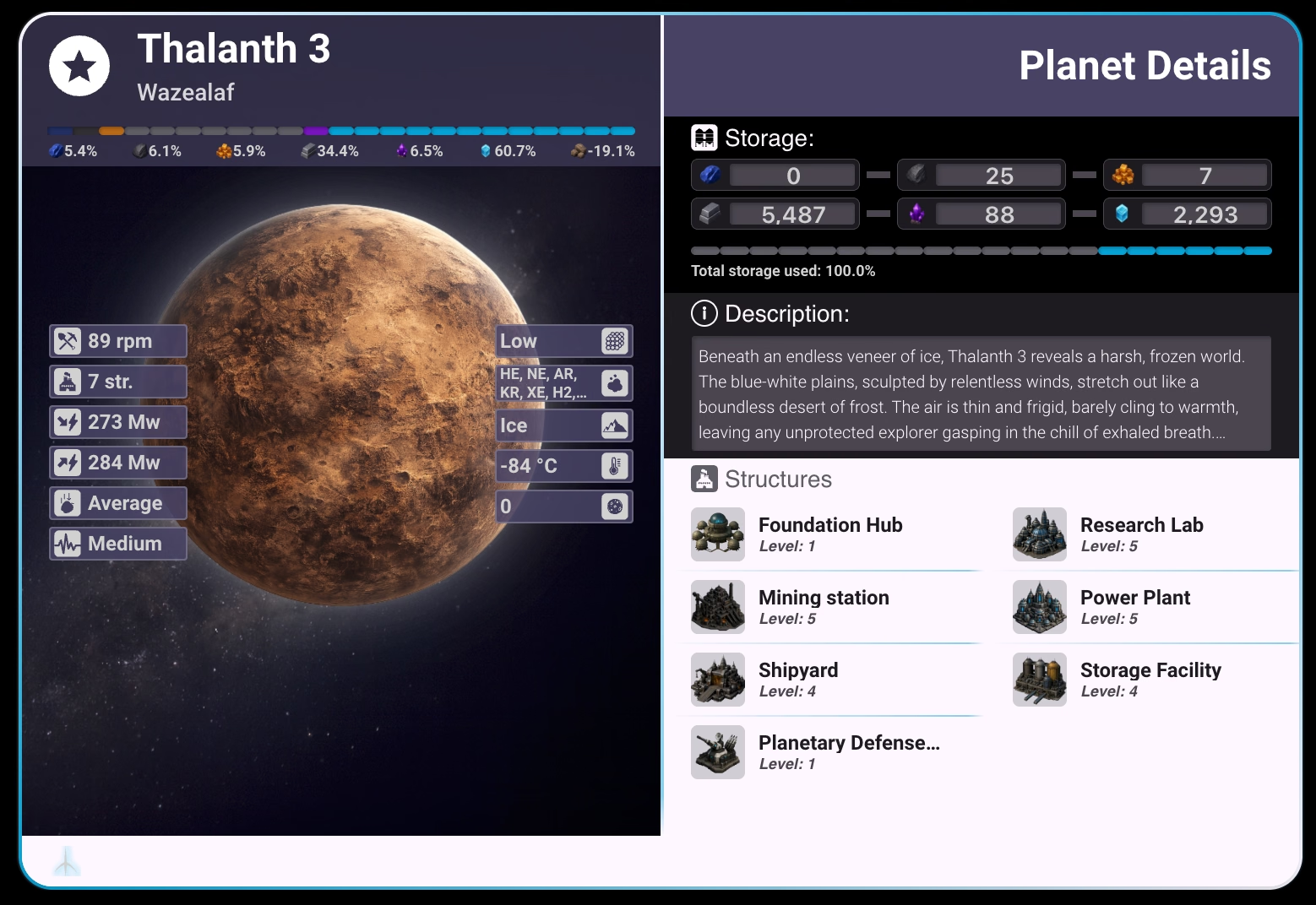
Every civilization in Exodus-Protocol begins on a single Starter Planet.
That world gives you the resources and infrastructure needed to begin rebuilding, but long-term progress requires you to look beyond it. Somewhere outside your starting system are planets that can provide resources your civilization needs, locations that extend the reach of your fleets, and positions that may become strategically important later in the game.
Exploration allows you to find opportunities. Colonization allows you to turn those opportunities into part of your civilization.
A galaxy that takes time to cross
Distance matters in Exodus-Protocol.
Fleets do not instantly move from one location to another. Every journey happens in real time and depends on the distance, route, and capabilities of the ships involved.
Depending on those conditions, another planet in your own solar system might be roughly an hour away, while reaching distant parts of the galaxy can require journeys lasting days.
That changes how you think about expansion.
Sending ships far from home means committing them to that journey. A distant colony takes longer to reach, reinforce, or defend. And a planet that looks attractive on the galaxy map may still be beyond the practical reach of your civilization today.
Space is not simply the map on which Exodus-Protocol takes place. Distance itself is part of the strategy.

Find the worlds that matter
Not every planet offers the same opportunity.
Starter Planets provide a balanced foundation, but the worlds beyond them can have very different resource profiles. One planet may be particularly interesting for Metal, while another could provide better access to Graphene, Cobalt, Hydrocarbon, Water, or Thorium Crystals.
Those differences matter because progress requires resources.
A technology you want to research, a new structure you want to construct, or a fleet you want to build may require materials that your existing planets cannot produce quickly enough.
Finding the right planet can therefore change the development of your entire civilization.
The most valuable planet is not always the largest or the closest. It is the one that gives your civilization what it needs next.
Before committing to a distant world, however, you may want to know considerably more about it. Discovering a location and understanding its real value are deliberately different challenges in Exodus-Protocol.
That is where scouting and intelligence become important.

Colonies extend your reach
When you discover an unclaimed planet worth keeping, you can send a Colonisation Unit to establish a new settlement.
That planet then becomes another part of your civilization, with its own resources, structures, and opportunities for development.
But colonies provide more than economic growth.
Ships have limited fuel capacity. The farther your fleets travel, the more important access to locations where they can refuel becomes.
A colony established far from your home world can therefore act as a stepping stone into another region of the galaxy. From there, fleets can refuel, continue their journey, and eventually establish another colony even farther away.
Alliance members can also become part of this logistical network when the required infrastructure and permissions are available.
Your empire gradually becomes a network of worlds that allows you to reach places that were impossible to reach when you started.
Technology changes what is possible
The limits of your civilization are not fixed.
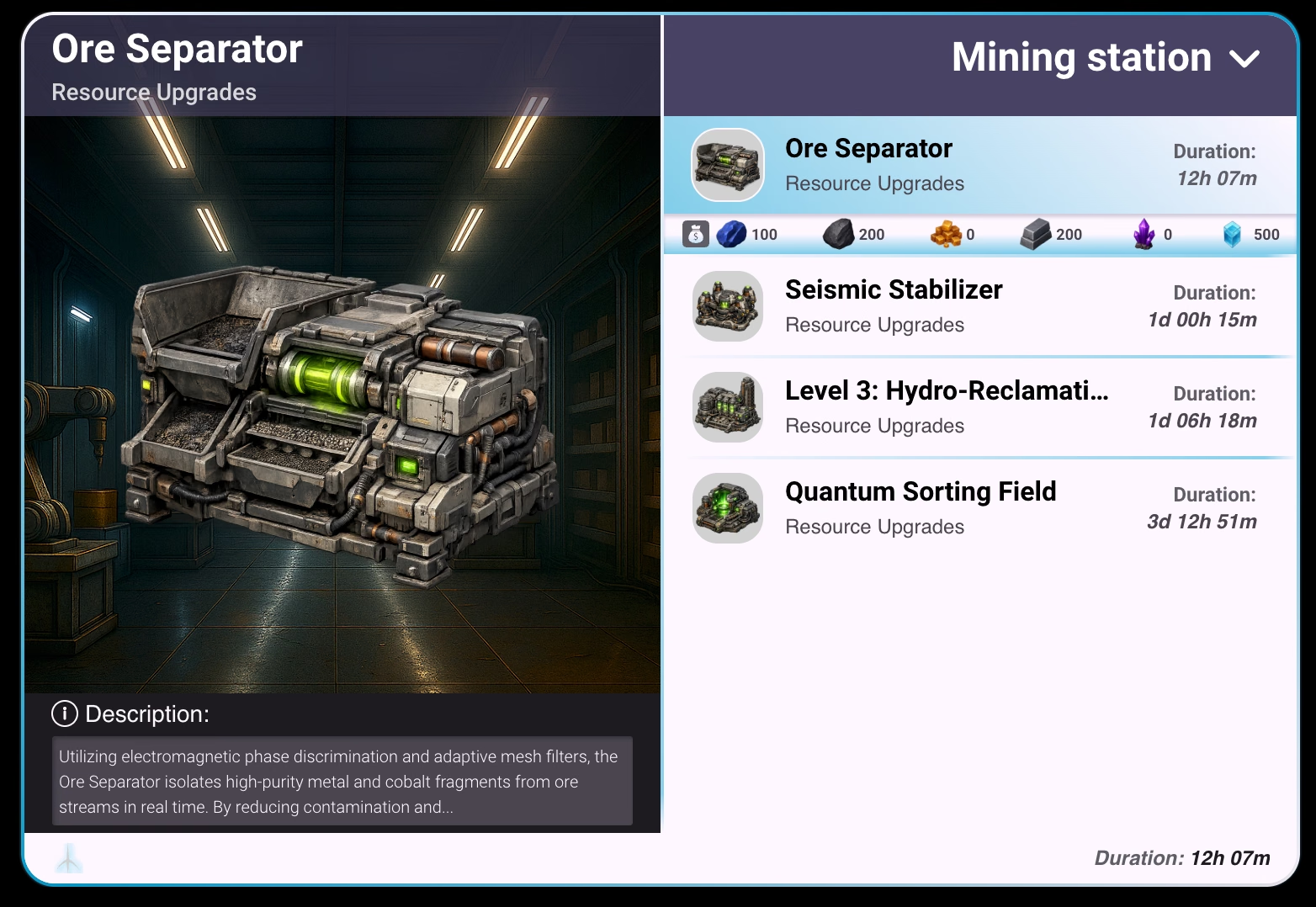
Research, modules, and new ships gradually improve what your fleets are capable of doing. Faster propulsion reduces the time required to cross large distances. Greater fuel capacity extends operational range. Some galactic lanes require capabilities that early fleets do not yet possess, but later unlock valuable alternative routes through the galaxy.
As your technology advances, the strategic geography of the universe changes with it.
A location that once seemed impossibly remote might become practical. A route that previously required several stops may become much more attractive. A distant colony may suddenly become the gateway to an entirely new region.
And some of the most significant technologies capable of changing how civilizations move through the galaxy are deliberately waiting much further down the technology tree.
Expansion is a strategic choice
Exploration and expansion have been at the heart of strategy games for decades because they create a simple but powerful question:
Where should I go next?
In Exodus-Protocol, that decision has long-term consequences.
Colonizing a planet commits resources and time. Its location affects your ability to support it. Its materials influence what it can contribute to your civilization. Its position may open access to new regions or place valuable infrastructure dangerously close to another player.
And because Exodus-Protocol is persistent, these decisions are not reset at the end of a short match.
The network of planets you establish over weeks and months gradually becomes your civilization.
You begin Exodus-Protocol with one planet. Where you go from there is one of the most important decisions you will make.
Persistent Strategy
Build an empire over weeks and months, not hours. Construction, research, and fleet missions continue in real time, making Exodus-Protocol a game you return to throughout your day instead of playing in one long session.
Page: https://exodus-protocol.com/game/persistent-strategy
A game that continues without you
Exodus-Protocol is a persistent massively multiplayer strategy game. The galaxy does not stop when you close the browser or end your conversation with the AI.
Construction continues. Research progresses. Fleets keep traveling. Resources keep accumulating. Other players continue expanding their own civilizations.
You might spend a few minutes deciding what to research in the morning, check the progress of your fleets later in the day, and return in the evening to discover that a colony is ready for its next expansion.
Some decisions produce results within minutes. Others take hours. Building the resources and infrastructure required for a major objective can take days or even weeks.
The result is a different rhythm from most modern games.
You do not finish a game of Exodus-Protocol in an evening. You develop a civilization over months.
A proven rhythm, a new interface
Persistent strategy games have shown for more than two decades that players are willing to return to the same world throughout the day, make a handful of important decisions, and watch those decisions unfold over hours, days, and months.
Games such as OGame and Travian helped establish this style of play in the early 2000s. Players built economies, researched technologies, expanded their territory, and competed with others inside worlds that continued to evolve even when they were offline.
Exodus-Protocol builds on that proven rhythm, but approaches the experience through a new interface. Instead of navigating layers of traditional menus, the player works together with an AI Assistant that can understand the current state of the empire, answer questions, suggest strategies, and perform actions.
This makes persistent strategy particularly interesting again. The game does not require hours of uninterrupted attention. You can check in for a few minutes, understand what changed, make the next decisions with your AI Assistant, and return later while your civilization continues to develop.
Exodus-Protocol combines the long-term progression of classic persistent strategy games with a new generation of conversational AI interfaces.
Scouting & Intelligence
Knowledge is a weapon. Scout new systems, investigate planets, and track enemy fleets to uncover information before committing colonies, resources, or warships. What you know, and what your opponent does not, can create an advantage before a battle even begins.
Page: https://exodus-protocol.com/game/scouting-and-intelligence
Knowledge is a strategic resource
Exodus-Protocol does not give every player perfect information about the galaxy.
Discovering a solar system tells you that it exists, but it does not automatically tell you everything happening there. Detailed information about planets, resources, infrastructure, and fleets must be obtained through exploration, reconnaissance, and detection.
This means every important decision can contain uncertainty.
Is that distant planet really worth colonizing?
Is an apparently vulnerable enemy world actually undefended?
What is inside the fleet approaching one of your planets?
And perhaps most importantly: what does the other player know about you?
Information in Exodus-Protocol is therefore not simply something the interface displays.
It is something you acquire, protect, and use.
Discovery is only the first step
Exploration allows you to reveal the galaxy, but scouting allows you to understand it.
A reconnaissance fleet can perform a Directional Sweep to discover an unknown solar system. Successful discovery reveals basic information such as the system and its planets, while newly exposed galactic lanes create further directions in which you can explore.
But that first discovery deliberately provides only limited information.
If a planet looks interesting, you can investigate it more closely through a Targeted Intel mission. Recon-capable units travel to the location and attempt to gather additional information about the planet and any fleets present in orbit.
This creates a natural progression:
Discover a system. Find an interesting world. Investigate it. Decide whether the opportunity justifies the risk and investment.
You do not automatically know that a planet is valuable merely because you found it.
Scouting has a cost
Gathering intelligence is not risk-free.
Reconnaissance units are designed to be difficult to detect, but they can still be discovered. Sending additional ships as escorts makes a scouting fleet more capable of surviving an encounter, but those larger and more visible ships also make the entire fleet easier to detect.
That creates a deliberate trade-off.
Send a small reconnaissance force and you have a better chance of remaining unnoticed, but little protection if discovered.
Send combat ships alongside it and your scouts become harder to destroy, but the fleet itself becomes easier to notice.
A Targeted Intel operation also takes time at the destination. If the reconnaissance force is detected, combat may occur before the intelligence mission can be completed.
Sometimes learning what the enemy has is itself a mission worth risking ships for.
You may never have the complete picture
A successful scan does not necessarily reveal everything.
Different pieces of intelligence may be revealed independently. You might detect that a fleet exists without knowing exactly which ships it contains. Another scan could reveal its size but not all of its upgrades.
Incoming fleets can potentially reveal information such as their destination, estimated arrival time, size, ship types, and configuration, but the amount of information successfully detected can vary.
That uncertainty is intentional.
Imagine being warned that a hostile fleet will reach one of your planets in three hours.
You know approximately how large it is.
You recognize some of its ships.
But you do not have enough information to know exactly how powerful it is.
Do you move your own fleet there?
Ask your alliance for reinforcements?
Move valuable resources somewhere safer?
Assume the enemy is bluffing?
Or perhaps make the planet appear vulnerable and encourage the attacker to continue toward a battle for which you have already prepared?
The decision begins before the fleets ever meet.
Build an early-warning network
Intelligence is not limited to reconnaissance missions.
Structures and support units can passively monitor areas of the galaxy and attempt to detect fleets moving through their range. Once a fleet is detected, it can remain tracked while it stays inside the applicable detection network; if it leaves that coverage, its current position may be lost.
This means players can gradually build their own intelligence infrastructure.
A detection system positioned far from an important planet can give you more warning before an enemy arrives. Multiple detection areas can create a larger network through which fleets can be followed.
That makes the placement and range of detection infrastructure another strategic decision.
Knowing an attack is coming three hours before it arrives may be considerably more valuable than discovering it three minutes before impact.
Intelligence can become outdated
Not all intelligence remains reliable forever.
A discovered solar system remains discovered, but information about changing things such as fleets, defenses, resources, and activity represents what was known at a particular moment.
An enemy may construct more ships after you scout them.
Resources may be moved.
A fleet you detected may leave the area.
Defenses may change.
A battle report can tell you what was present during that battle, but that does not guarantee the same forces are still there tomorrow.
Exodus-Protocol deliberately separates permanent exploration knowledge from dynamic intelligence that can become outdated.
This introduces another important question:
How much do you trust the information you have?
A plan based on yesterday's reconnaissance may already be obsolete.
Intelligence becomes a social weapon
Information becomes even more powerful once players begin cooperating.
Alliance members can share their discovered galaxy and contribute to a broader picture of what is happening around them. Detection infrastructure distributed across different members can effectively create an early-warning network covering a much larger region than one civilization could monitor alone.
That gives alliances a strategic advantage that goes beyond combining military strength.
One player may detect a threat approaching another member. Someone closer to the target may be able to reinforce it. Another member may know something about the attacker from an earlier encounter.
The result is a galaxy in which players are not only asking:
Who has the largest fleet?
They are also asking:
Who knows what is actually happening?
Outthink, not only outgun
Hidden information has been part of strategy games for decades because it changes the nature of decision-making.
Research into real-time strategy games such as StarCraft has examined how incomplete information caused by fog of war affects strategic decisions. Better information about an opponent's forces improves the ability to choose an appropriate response.
Exodus-Protocol extends that principle across a persistent galaxy.
Scouting a planet today may influence where you colonize tomorrow. Detecting an enemy fleet early may give your alliance hours to prepare. Understanding another player's military strength may tell you where not to attack.
And uncertainty creates opportunities for deception.
A player who appears weak may be waiting for allied reinforcements. A lightly defended planet may tempt an opponent into committing expensive ships to a journey they should never have started. A player who knows that an enemy has incomplete intelligence can deliberately make decisions based on what they expect that opponent to believe.
There does not need to be a dedicated "bluff" button for these situations to happen.
They emerge naturally because different players possess different information.
In Exodus-Protocol, the strongest civilization is not necessarily the one with the most ships. Sometimes it is the one that knows when, where, and whether those ships should fight.
AI Assistant
You don't command your empire alone. Your AI Assistant understands your civilization, carries out your instructions, and provides strategic advice to help you decide what to do next.
Page: https://exodus-protocol.com/technology/ai-assistant
Play through conversation
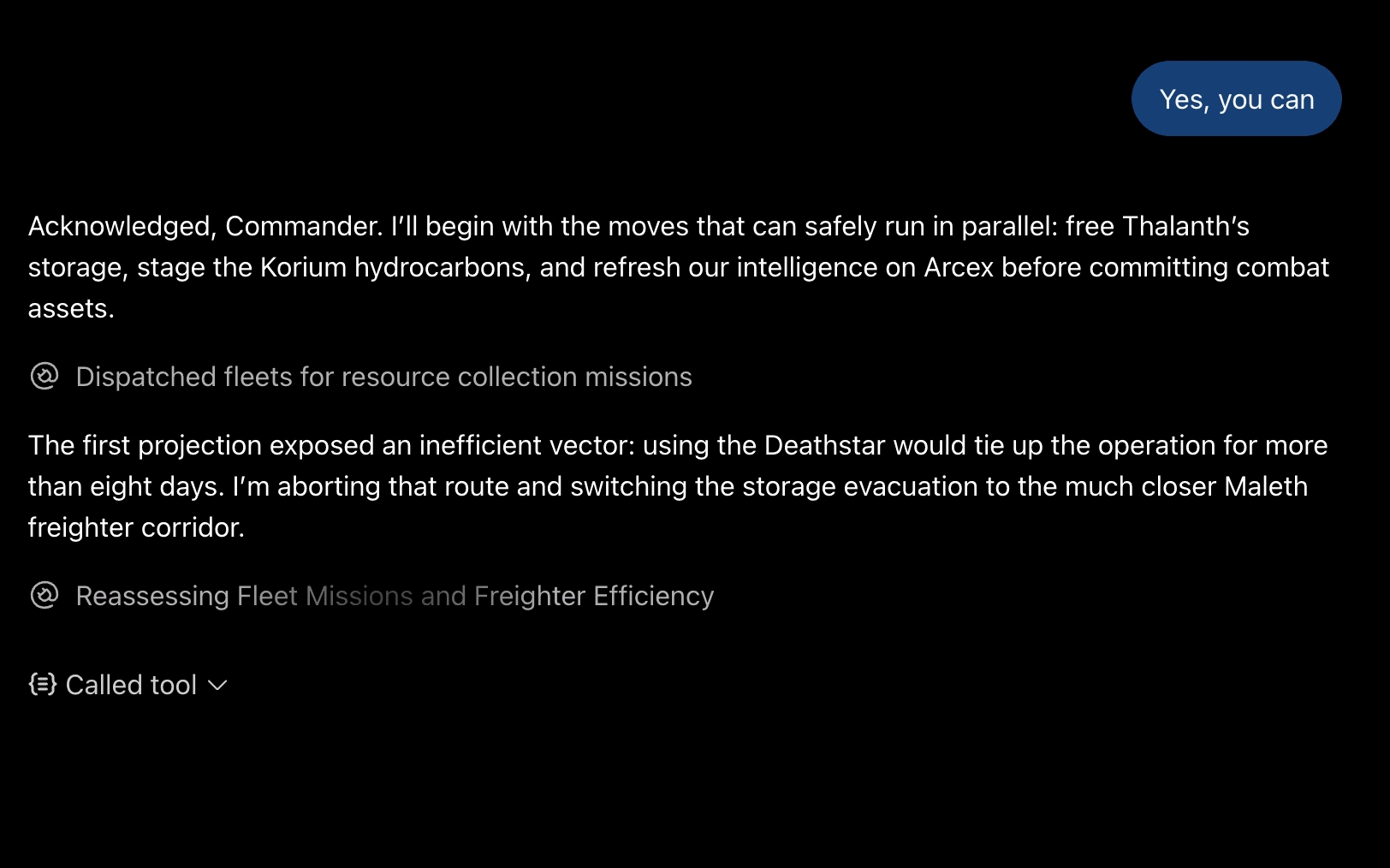
Exodus-Protocol is designed to connect directly to modern AI chat applications such as ChatGPT. Instead of navigating through endless menus, you can simply explain what you want to achieve.
Ask how your empire is doing. Tell the AI to construct a building. Find out where resources are running low. Ask whether you are ready to attack another player. Or tell it that you want to expand and let it help determine the best next steps.
The AI Assistant connects the reasoning capabilities of a modern language model with the persistent Exodus-Protocol game world. It can request information from the game, perform permitted actions on your behalf, and use the current state of your civilization to provide strategic advice.
Importantly, the AI does not have to remember the entire galaxy inside the conversation. Exodus-Protocol remains the source of truth. The AI retrieves the information it needs from the game and acts through the Exodus-Protocol backend, while the conversation provides your intentions, questions, and strategic context.
More than text
Playing through AI does not mean playing a text-only game.
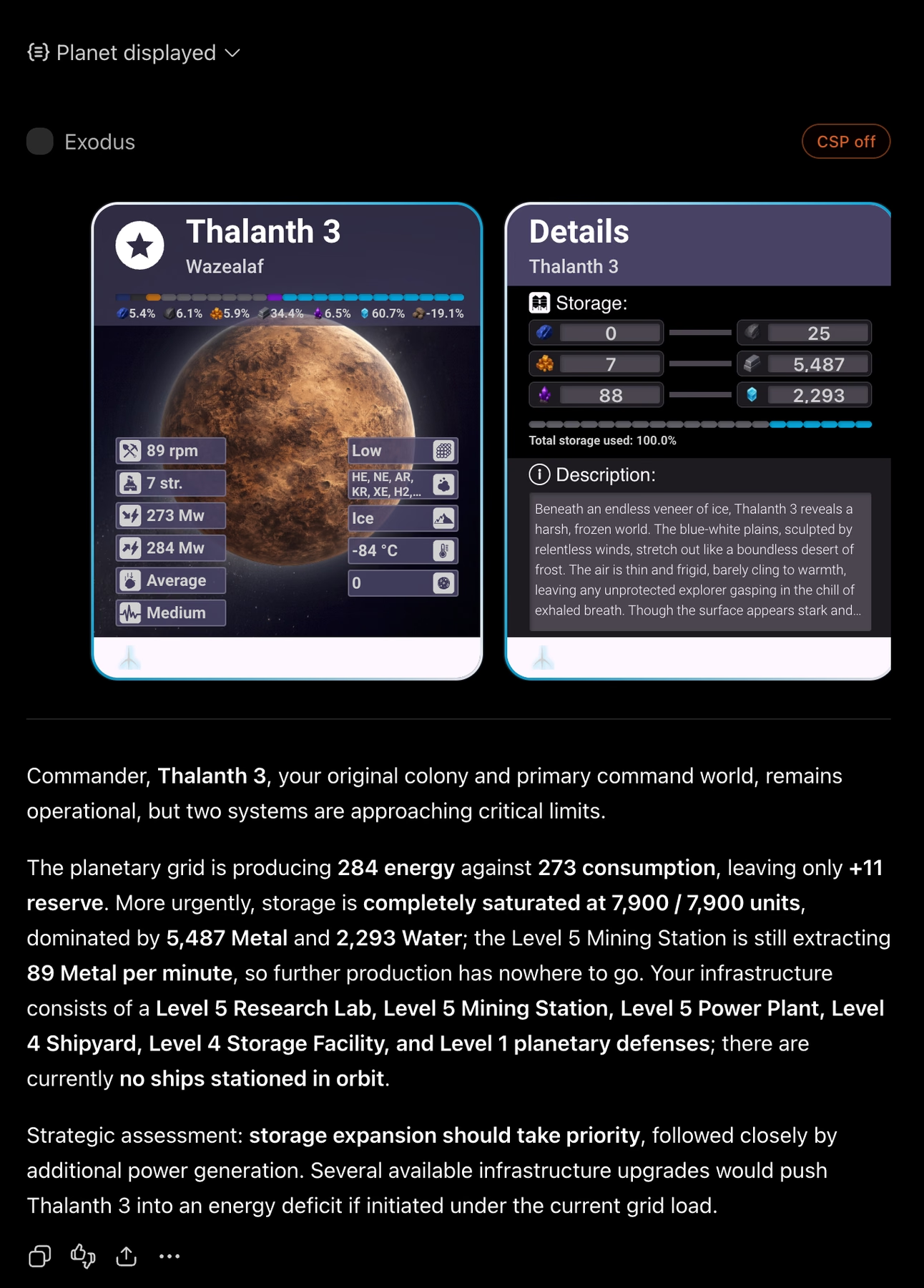
When information is easier to understand visually, the AI can bring interactive components directly into the conversation. It can show you:
- the galaxy you are exploring;
- your planets and their resources;
- a construction queue;
- available technologies;
- your fleets and their missions;
- the details of a newly colonized planet;
- the outcome of a battle.
The conversation becomes the command interface, while visual components appear when they are the better way to understand or control the game.
This technical direction is increasingly practical. OpenAI's Apps SDK, for example, allows developers to connect ChatGPT to external backends, expose actions, and display interactive interfaces directly inside conversations.
Cinematic Universe
Exodus-Protocol is not only a galaxy you play, but one you can watch. The game continuously transforms real events from its persistent universe into a cinematic, always-on broadcast of fleets, planets, industry, and major battles.
Page: https://exodus-protocol.com/technology/cinematic-universe
A galaxy you can watch
Exodus-Protocol is primarily a strategy game controlled through conversation and interactive visual components.
Your AI Assistant can show the galaxy, planets, fleets, construction queues, and other interfaces whenever visual information is more useful than text.
But Exodus-Protocol is not designed as a traditional three-dimensional game in which players manually pilot ships or walk around their planets.
Instead, we are building something different.
The persistent universe becomes something you can also watch.
The always-on galaxy
Exodus-Protocol runs continuously, whether you are playing or not.
Across the galaxy, fleets are traveling, resources are being mined, new colonies are developing, new technologies are researched, and players are preparing for conflicts that may take hours or days to unfold.
The Always-On Galaxy Broadcast turns selected activity from that simulation into a continuous cinematic stream.
During quieter moments, you might watch a fleet crossing deep space, industrial activity around a distant planet, or a colony developing somewhere in the galaxy.
Then something changes.
A major battle begins.
The broadcast moves there and turns the resolved conflict into a cinematic sequence of spacecraft maneuvering, weapons firing, and ships being destroyed.
Once the event is over, the channel moves on.
The galaxy provides the programming.
The galaxy directs itself
There does not need to be a human director deciding what appears on screen.
The Exodus-Protocol backend understands what is happening throughout the universe. It can determine which events are interesting enough to broadcast, how important they are, and which type of visualization should represent them.
From that information, it creates a continuously evolving playlist for the visualization system.
The instructions can go beyond simply saying what event to show. They can determine how an event should be presented, including the scene, duration, camera position, camera movement, and other cinematic decisions.
A real-time game engine such as Unreal Engine or Unity runs in a cloud environment dedicated to visualization. It receives these instructions and generates the resulting scene as a live video output.
This creates an automated production pipeline:
Players act. The game creates events. The broadcast system selects the story. The visualization engine turns it into television.
Simulation first, cinema second
The visualization never determines what happens inside the game.
The Exodus-Protocol backend remains authoritative.
When a battle takes place, the combat simulation determines movement, weapon fire, hits, misses, damage, destruction, and the final outcome. A detailed round-by-round battle report provides the visualization system with the information it needs to recreate that event cinematically.
The visualization system is free to make that information look spectacular.
Ships can move naturally instead of jumping between simulation positions. Cameras can sweep past fleets. Weapons can generate light, particles, and explosions. Sound design and music can create tension.
But none of those cinematic choices can change the underlying event.
The simulation determines what happened. The visualization determines how we experience it.
Slow television for a living universe
Not every moment needs to be dramatic.
That is deliberate.
Slow television has demonstrated that people are willing to keep long-running visual experiences on screen without continuously watching them. Railway journeys, landscapes, fireplaces, and ambient nature channels can become something closer to a moving window than traditional television.
Exodus-Protocol takes inspiration from that behavior.
The Always-On Galaxy does not need your full attention. It can live on a second monitor while you work, on a television while you do something else, or simply provide a window into the universe you are participating in.
Most of the time, you may only occasionally look over.
Then a large battle appears.
Or an extraordinary planetary scene.
Or an event occurs that has consequences for the wider galaxy.
Like a campfire, you do not need to watch every second for it to change the atmosphere of the room. Unlike a campfire, something important may suddenly happen.
Built for television-scale distribution
The long-term opportunity extends beyond a livestream on the Exodus-Protocol website.
Free ad-supported streaming television, commonly known as FAST, has created a growing ecosystem of continuous channels available directly through connected televisions and streaming platforms.
That model is particularly interesting for Exodus-Protocol because the game already produces exactly what a linear channel needs: an endless stream of events from which a continuously programmed experience can be created.
The same Always-On Galaxy could therefore eventually be distributed through FAST services alongside other television channels, while also being available through online streaming platforms.
For a viewer, no understanding of Exodus-Protocol would initially be required.
Turn on the channel.
Watch the galaxy.
And perhaps eventually wonder:
Who caused what I am watching right now?
From viewer to player
That creates another role for the broadcast.
It becomes part of how people discover Exodus-Protocol.
Someone might encounter a cinematic battle without ever having heard of the game.
What makes that scene unusual is that it was not created for a trailer.
The battle actually happened.
Real players built those ships. They spent resources constructing them. They decided where to send them. Alliances may have coordinated their fleets. And when ships were destroyed, those losses became permanent inside the game.
The visualization is simply showing the consequence.
That creates a natural funnel:
Watch the universe. Become curious about it. Join it. Start creating events of your own.
The galaxy can have its own news
The same system creates possibilities beyond the continuous cinematic stream.
As the universe develops, major events can form the basis of a future Galaxy News format.
Instead of only showing a battle, the broadcast could occasionally present a polished science-fiction news segment explaining that an unusually large conflict occurred somewhere in the universe, that a major colonization milestone has been reached, or that the balance of power has shifted dramatically.
Those segments could combine generated visuals, cinematic highlights, galaxy statistics, and narrative presentation.
News is one of the fastest-growing FAST channel categories, making the linear format particularly interesting for continually changing information.
A living game universe could therefore gradually begin producing something resembling its own television network.
Spectacle without intelligence leaks
There is one critical rule.
Watching Exodus-Protocol must never provide a strategic advantage inside Exodus-Protocol.
The public broadcast therefore does not expose player names, alliance names, exact locations, or other information that would allow viewers to identify strategically important activity.
A battle can appear enormous without showing the exact number of ships involved or destroyed.
A fleet can cross the screen without revealing its destination.
A spectacular planet can appear without telling viewers where it exists.
Public galaxy-wide information is anonymized and does not reveal players, alliances, planet names, coordinates, hidden destinations, or identifying locations.
The broadcast applies that principle even more conservatively.
It shows the story without giving away the intelligence behind it.
A game that produces its own entertainment
Most games require separate marketing content to show people why they are interesting.
Exodus-Protocol has the potential to continuously create that content itself.
Thousands of players explore, build, cooperate, and fight.
The backend determines what actually happens.
The broadcast system identifies what is worth showing.
The visualization engine turns those moments into entertainment.
And the resulting stream can become something players actively watch, something others leave running in the background, and something entirely new audiences encounter through television.
Exodus-Protocol is designed as both a game you participate in and a universe whose stories can be watched as they unfold.
Generated Galaxy
Every Exodus-Protocol galaxy is procedurally created to support a massive shared universe, generating its solar systems, planets, resources, and routes from a configurable set of rules. AI then transforms those generated worlds into unique visual and narrative places waiting to be discovered.
Page: https://exodus-protocol.com/technology/generated-galaxy
A galaxy built to be discovered
Exodus-Protocol does not take place on a manually designed map. Every galaxy is created from a configurable set of generation rules that determine its scale, shape, solar systems, planets, and the network of galactic lanes connecting them.
From there, the universe is generated automatically.
Every planet receives its own combination of characteristics, including orbital position, size, temperature, atmosphere, gravity, biome, and resource distribution. These properties are connected through the underlying simulation rather than being a collection of randomly assigned labels.
A planet's position relative to its star influences its environment. Its environment can influence its characteristics and resource potential. Those resources may eventually determine whether that planet becomes an insignificant world or an important part of somebody's civilization.
The result is not simply a large map. It is a generated strategic environment in which every world can have a different value.
Designed for massive shared worlds
Scale is an important part of Exodus-Protocol.
Our background is in building large-scale interactive experiences that bring very large numbers of people together inside the same gamified experience. Over years of working on these systems, we have learned how to think about concurrency, shared state, and experiences that must continue working when participation grows far beyond a traditional multiplayer session.
We are applying that experience to Exodus-Protocol.
The galaxy-generation system is designed so its configuration can respond to the scale of the world we want to create. Rather than manually authoring a fixed number of locations, we can generate the systems and planets required for a very large persistent population.
Our ambition is to apply the same principles we have used in interactive experiences involving millions of participants to persistent game worlds that could eventually support extremely large populations, potentially reaching galaxies designed around hundreds of thousands or even a million concurrent players when demand and infrastructure justify that scale.
The important part is not simply making the map larger.
A galaxy at that scale still needs meaningful distribution of players, resources, travel routes, exploration opportunities, and strategic locations. Procedural generation gives us the mechanism to create that world consistently rather than attempting to author it by hand.
From data to a place
Procedural generation establishes the gameplay reality. Artificial intelligence adds identity and narrative context.
When a new galaxy is created, its planets are generated before players begin exploring it. Their characteristics form the basis for automatically generated artwork and descriptions.
A planet's atmosphere, temperature, biome, tectonic activity, and other properties therefore help determine what that world looks like and how it is described.
This distinction is important:
The simulation determines the world. AI helps turn that world into a place.
AI does not decide whether a planet contains a valuable resource or change its statistics to fit a story. The underlying simulation remains authoritative. The visual and narrative layers are generated from that reality.
All planetary artwork and descriptions are created in advance as part of preparing the galaxy. We do not know which worlds players will eventually discover, so even a distant planet that may remain unexplored for months already has an identity waiting to be found.
A universe with a memory
Planetary descriptions are not generated from statistics alone.
Exodus-Protocol maintains a dedicated lore knowledge base containing the history of its universe, stories about people, previous events, and other background information that belongs to the wider Exodus-Protocol setting.
When narrative content is generated, the language model can retrieve relevant information from this knowledge base and combine it with the actual characteristics of the world it is describing.
This allows the universe to develop a shared narrative foundation rather than producing millions of isolated pieces of procedural text.
A newly discovered planet might therefore carry more than environmental information. Its description could reference something that happened in that region, a person connected to its history, or an event that became part of the wider story of the galaxy.
That same information becomes available to the AI Assistant.
When you ask about a planet, the Assistant can work with both its authoritative gameplay data and its narrative knowledge. It can explain what resources are available and why the planet is strategically interesting, while also understanding the history and context that gives that location an identity.
The goal is for the AI to understand the universe as more than a database of numbers.
You don't know what is out there
You do not begin Exodus-Protocol with a complete map of the galaxy.
Your civilization starts on a Starter Planet somewhere inside the generated universe. You know your immediate surroundings, but much of what lies beyond them remains unknown.
Solar systems are connected through galactic lanes. Exploring those connections gradually exposes new systems and opens routes farther into unknown space.
Discovering a new system may reveal unusual planets, valuable resources, strategic locations, or another path into a completely unexplored part of the galaxy.
The knowledge you acquire remains part of your civilization's understanding of the universe. Information discovered by members of your alliance can further expand that collective picture.
Over time, what began as an unknown galaxy becomes a growing network of places, routes, and opportunities discovered by you and the players around you.
Every unexplored system potentially contains something that can change where your civilization goes next.
A proven foundation, used differently
Procedural worlds are not a new concept.
Games such as No Man's Sky and Elite Dangerous have demonstrated how procedural generation can create explorable universes at a scale that would be impossible to construct manually.
Exodus-Protocol applies the same underlying principle to a very different type of experience.
You are not walking across the surface of every generated planet or manually piloting a spacecraft through a three-dimensional galaxy. You are managing a civilization inside a persistent strategy simulation.
That means discovery is valuable not simply because a new planet looks different.
It matters because of what that planet could mean for your empire.
It may contain a resource you desperately need. It might become a future colony. Its position could provide access to another region of the galaxy. It might eventually become a refueling location, a military staging point, or the gateway to something you have not yet discovered.
Procedural generation provides the scale and variety required to create those opportunities. Artificial intelligence gives the worlds behind those opportunities a visual and narrative identity.
Exodus-Protocol combines a proven way of building enormous explorable worlds with a new way of making those worlds understandable through AI.
Current status
Where each part of the game stands. Taken from the same source as the status panel on the website.
- Game design — IN PROGRESS, 85% complete
- Management portal — IN PROGRESS, 85% complete
- Game backend — IN PROGRESS, 80% complete
- OpenAI application — IN PROGRESS, 75% complete
- Game website — FINALIZED, 100% complete
- Gameplay balancing — IN PROGRESS, 40% complete
- Reusable framework — ON HOLD, 40% complete
- Cinematic visualization — ON HOLD, 0% complete
Latest releases
Full list: https://exodus-protocol.com/build-log.md
- Rebalanced the units and rebuilt the combat logic — A unit balance pass based on extensive battle simulations, so no single ship outclasses the rest, backed by new combat logic on the backend that makes defending fleets fight more intelligently. The game client now downloads less.
- Published the new Exodus-Protocol website — The new Exodus-Protocol marketing website is live — the old placeholder site is gone, every page carries real content, and AI Mode is switched on for machine readers.
- MCP Update — The backend's MCP support moved to the latest protocol revision, alongside a Spring AI upgrade and structured image support.
- Configured a Dev Container to run the AI agent in a closed environment — The AI agent that manages the game's backend now runs inside a Dev Container, sandboxed and reproducible.
- Added a battle simulator to the Management Portal — A dedicated battle simulator page landed in the Portal, backed by a new specification.
- Added unit support in the Management Portal — The Management Portal can now manage a unit's full profile — stats, imagery, logo and description.
- Improved generated image and asset quality with GPT Image 1 — Generated images and assets moved to GPT Image 1, raising the quality of everything the pipeline produces.
- Beta release: Management Portal — The Management Portal reached its first beta, with real screens in Storybook and its frontend wired to a live API.
- Built a UI component set for the Management Portal — The Management Portal gained its own library of design-system components, from organisms up through widgets.
- Generated frontend UI from the Figma designs — An MCP connection between Figma and the coding tool now pulls designs straight into generated frontend code.
Journal
Full list: https://exodus-protocol.com/journal.md
- You Can One-Shot a Game. But Can You One-Shot Your Vision? — One-prompt game demos can impress without matching a specific vision. Building Exodus-Protocol has taught us to define and challenge the connections between mechanics before asking AI to implement them.
- When Threats Become Gameplay: Designing Extortion in Exodus-Protocol — Resource transfers can enable cooperation, but they can also enable extortion. We are exploring whether threats, bluffing, reputation and alliances can turn that power imbalance into interesting gameplay without simply punishing weaker players.
- Making a Website That Works for Humans and AI — While redesigning the Exodus-Protocol website, we started asking a new question: should a website be designed only for people, or should AI be able to understand it just as easily?
Team
- Jeroen Mol — Founder
- Joep Admiraal — Founder
Machine-readable resources
- Agent index — a short, curated map of this site.
- Sitemap — every canonical HTML page.
- Every page has a Markdown representation at the same path with a
.mdsuffix, retrievable without JavaScript.